

Five years ago, if you asked someone about CoolPeel®, you probably would have been met with a blank stare.
Today, it’s one of the fastest-growing laser skin rejuvenation treatments in aesthetic medicine.
Dermatology practices, plastic surgeons, and medical spas across the country are talking about it. Social media is filled with before-and-after photos. Patients are asking for it by name. And many providers are calling it one of the biggest advancements in fractional CO2 laser technology in years.
So what changed?
It wasn’t that wrinkles suddenly became more common.
It wasn’t that sun damage became a bigger problem.
And it certainly wasn’t because traditional CO2 laser resurfacing stopped working.
The difference was technology.
For decades, CO2 laser resurfacing has been considered one of the gold standards for improving skin texture, wrinkles, acne scars, and signs of sun damage. The results have always been impressive—but the recovery associated with older CO2 systems wasn’t right for everyone.
Many patients simply couldn’t take one to two weeks away from work, family, or social activities while their skin healed.
Researchers and laser manufacturers began asking an important question:
Could patients experience the rejuvenating benefits of CO2 laser resurfacing with less unnecessary heat and a more manageable recovery?
That question ultimately led to the development of technologies like CoolPeel®.
Today, CoolPeel has helped introduce a new generation of patients to CO2 laser resurfacing—people who may never have considered the treatment before because of concerns about downtime.
While every patient is different and recovery varies depending on treatment settings and individual skin characteristics, many people appreciate that CoolPeel can offer noticeable skin rejuvenation with a different treatment experience than traditional fully ablative CO2 resurfacing.
But despite all the attention it’s receiving, one misconception continues to surface.
Many people assume CoolPeel is its own laser.
It isn’t.
Understanding what CoolPeel actually is—and how it works—helps explain why it has become one of the most talked-about skin rejuvenation treatments available today.
More Than a Trend—A New Generation of CO2 Technology
One of the reasons CoolPeel has generated so much interest is that it represents an evolution of a treatment physicians have trusted for decades.
Traditional CO2 laser resurfacing has long been recognized for its ability to improve the appearance of:
- Fine lines and wrinkles
- Sun damage
- Uneven skin texture
- Acne scars
- Enlarged pores
- Overall skin quality
The challenge was never whether CO2 lasers worked.
The challenge was balancing results with recovery.
Advances in laser engineering have made it possible to deliver energy with greater precision than earlier generations of CO2 systems. That precision allows aesthetic providers to tailor treatments based on each patient’s skin concerns, lifestyle, and goals.
Rather than thinking of CoolPeel as replacing traditional CO2 resurfacing, it’s more accurate to think of it as another option along the spectrum of modern skin resurfacing treatments.
Some patients benefit from lighter treatments with shorter recovery periods.
Others may be better candidates for deeper resurfacing when more significant correction is desired.
The key is choosing the right approach for the individual—not assuming one treatment fits everyone.
That’s why consultation and treatment customization remain just as important as the technology itself.
What Exactly Is CoolPeel?
One of the biggest misconceptions about CoolPeel is that it’s a completely different type of laser.
It isn’t.
CoolPeel is actually a treatment performed using advanced fractional CO2 laser technology. The name “CoolPeel” refers to a specific treatment approach made possible by the DEKA SmartXide Tetra® CO2 laser platform.
To understand why that’s important, it helps to take a quick look at how CO2 laser resurfacing has evolved over the years.
For decades, CO2 lasers have been considered one of the most effective non-surgical options for improving skin quality. Dermatologists and aesthetic providers have relied on this technology to help address visible signs of aging, acne scars, sun damage, uneven texture, and other common skin concerns.
The challenge wasn’t whether CO2 lasers worked.
The challenge was how they delivered their results.
Earlier generations of CO2 lasers treated the skin by removing damaged tissue while also generating significant heat. That heat played an important role in collagen remodeling, but it also contributed to longer recovery times for many patients.
As laser technology advanced, manufacturers focused on one goal:
Deliver laser energy more precisely while minimizing unnecessary thermal injury to surrounding tissue.
That evolution led to systems like the DEKA SmartXide Tetra platform.
Rather than simply increasing power, modern CO2 technology gives providers far greater control over how energy is delivered to the skin. This allows treatments to be customized based on each patient’s goals, skin condition, and desired level of correction.
CoolPeel is one example of how those technological advancements are being used to create a different treatment experience for appropriate candidates.
Understanding Fractional CO2 Technology
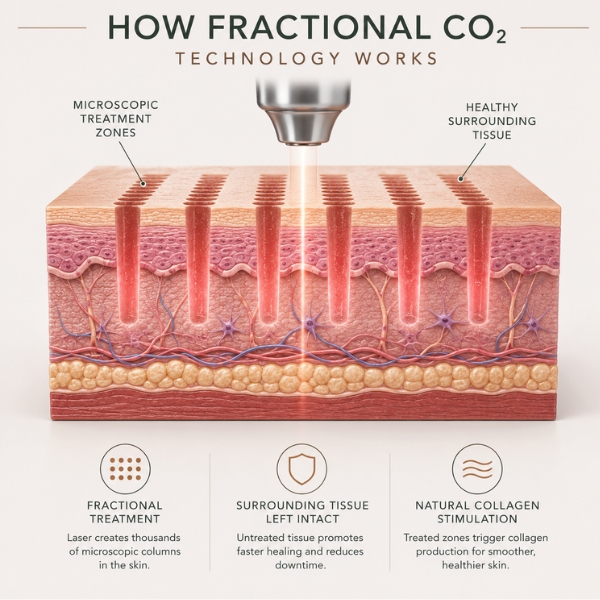 If you’ve heard the phrase fractional laser, you may have wondered what it actually means.
The easiest way to understand it is to imagine watering a lawn.
If you flooded the entire yard at once, every square inch would become saturated.
Instead, modern irrigation systems distribute water in a controlled pattern, allowing each area to receive exactly what it needs while the surrounding grass remains healthy.
Fractional laser technology works in a similar way.
Instead of treating every square millimeter of skin, the laser creates thousands of microscopic treatment zones across the surface.
These tiny columns of treatment stimulate your body’s natural healing response while leaving healthy surrounding tissue intact.
That untreated tissue becomes incredibly important.
It helps support the healing process by allowing new skin cells to regenerate more efficiently, which is one of the reasons fractional laser treatments have become so popular in aesthetic medicine.
Rather than removing the entire surface of the skin, fractional technology encourages your body to rebuild healthier skin from within.
Meet the Technology Behind CoolPeel: DEKA SmartXide Tetra®
At Evolve Wellness & Aesthetics, CoolPeel treatments are performed using the DEKA SmartXide Tetra®, one of today’s most advanced fractional CO2 laser platforms.
While patients often recognize the name “CoolPeel,” it’s helpful to understand that the technology powering the treatment is equally important.
The SmartXide Tetra system gives providers the ability to customize treatment settings based on each individual’s skin concerns and treatment goals. Rather than offering a one-size-fits-all approach, it provides flexibility that allows treatments to be tailored to the patient.
This customization is one of the reasons consultation is such an important part of the process.
Some patients may benefit from lighter resurfacing designed to refresh skin quality with a shorter recovery period.
Others may be candidates for deeper resurfacing when more significant correction is appropriate.
Because every person’s skin ages differently—and every patient has different goals—having technology that allows for individualized treatment planning is a significant advantage.
At Evolve Wellness & Aesthetics, every treatment begins with a comprehensive evaluation of your skin so your provider can recommend the most appropriate resurfacing approach for your needs.
Why Precision Matters
Modern laser technology isn’t simply about making treatments stronger.
In many cases, it’s about making treatments smarter.
Greater precision allows providers to focus laser energy where it’s needed while carefully controlling treatment depth and intensity.
That level of customization helps create treatment plans that are based on the individual rather than following a standard protocol.
It’s one of the reasons advanced CO2 laser resurfacing continues to evolve—and why patients today have more options than ever before when considering skin rejuvenation.
Key Takeaways
By now, we’ve answered several important questions:
✔ CoolPeel is not a separate laser—it’s a treatment performed using advanced CO2 laser technology.
✔ The DEKA SmartXide Tetra platform allows providers to customize treatments for different skin concerns and recovery preferences.
✔ Fractional CO2 technology works by creating microscopic treatment zones that encourage the skin’s natural healing process.
✔ Advances in laser precision have helped make modern resurfacing treatments more customizable than earlier generations.
Want to learn more about advanced CO2 laser resurfacing and how it may improve skin texture, wrinkles, acne scars, and sun damage? Explore CO2 Laser Resurfacing in Tucson.