
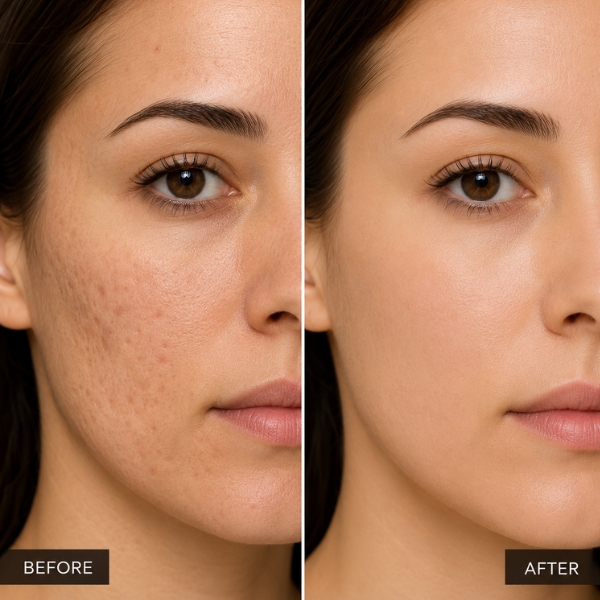
For many people, acne doesn’t end when the breakouts disappear.
Long after the inflammation has healed, acne scars can remain as a daily reminder of years spent trying different cleansers, medications, and skincare routines. While makeup may help camouflage discoloration, it often settles into uneven texture, making scars appear even more noticeable. Others find themselves avoiding certain lighting or camera angles because the texture of their skin is more visible than they’d like.
If this sounds familiar, you’re not alone.
Acne scarring is one of the most common reasons people begin researching laser skin resurfacing. In fact, one of the first questions patients ask during a consultation is:
“Can a CO2 laser actually improve acne scars?” The answer is yes—but understanding how it works is just as important as understanding what results to expect.
Contrary to what many people believe, CO2 laser resurfacing doesn’t “erase” scars or replace damaged skin overnight.
Instead, it works with your body’s natural healing process.
By stimulating new collagen production beneath the surface of the skin, advanced CO2 laser technology helps improve the appearance of depressed scars over time. As collagen rebuilds and reorganizes, the skin gradually becomes smoother, healthier-looking, and more even in texture.
For many patients, improvements continue developing for several months after treatment because collagen remodeling is an ongoing biological process.
That’s one of the reasons CO2 laser resurfacing has remained one of the most respected technologies in aesthetic medicine for decades.
Why Acne Scars Form
To understand why CO2 laser resurfacing can improve acne scars, it helps to understand how scars develop in the first place.
Healthy skin relies on collagen.
Collagen is the structural protein that gives skin its strength, firmness, and smooth appearance. Think of it as the framework that supports everything above it.
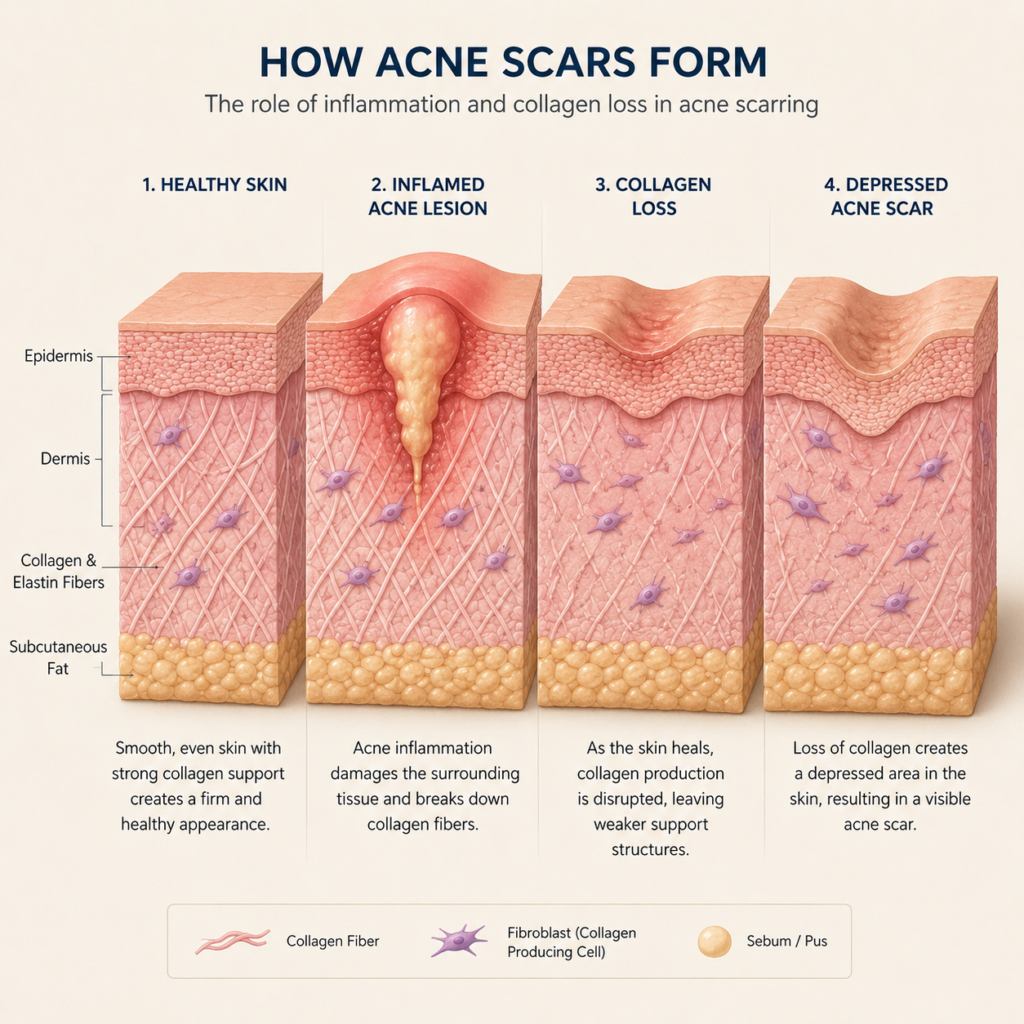
When an inflamed acne lesion develops, the body sends inflammatory cells into the area to fight bacteria and begin the healing process. Unfortunately, severe inflammation doesn’t just affect the surface of the skin—it can also damage collagen deep within the dermis.
As the blemish heals, the body attempts to repair the damaged tissue.
Sometimes that repair process doesn’t restore collagen evenly.
When too little collagen is produced, portions of the skin lose support and sink below the surrounding surface. These become atrophic scars, which are the most common type of acne scars seen on the face.
Less commonly, the body produces too much collagen, creating raised scars known as hypertrophic scars or keloids.
Because acne scars develop beneath the surface of the skin, they cannot usually be corrected with topical skincare products alone.
While cleansers, exfoliants, retinoids, and brightening products can improve skin tone and overall skin health, they cannot rebuild collagen that has already been lost.
This is where collagen-stimulating treatments like fractional CO2 laser resurfacing become valuable.
Instead of simply treating the surface, the goal is to encourage your skin to rebuild itself from within.
Not All Acne Scars Are the Same
One of the biggest misconceptions about acne scars is that they’re all treated the same way.
They’re not.
Different scar types develop for different reasons, and understanding those differences helps explain why every treatment plan should be customized.
Ice Pick Scars
Ice pick scars are small but very deep.
They resemble tiny puncture marks that extend into the skin, almost as though the skin had been pierced by a sharp object.
Because they extend deeper into the dermis than many other scar types, ice pick scars can be among the most challenging to improve.
In some cases, providers recommend combining treatments to achieve the best possible outcome.
Boxcar Scars
Boxcar scars are wider than ice pick scars and have clearly defined edges.
Instead of looking like narrow holes, they resemble shallow craters with relatively flat bottoms.
These scars often develop after inflammatory acne damages larger areas of collagen beneath the skin.
Because boxcar scars involve broader collagen loss, they frequently respond well to collagen-remodeling procedures.
Rolling Scars
Rolling scars create soft waves or uneven texture across the skin.
Rather than having sharp edges, these scars develop when fibrous bands beneath the skin pull the surface downward, creating gentle depressions.
Many patients describe rolling scars as giving their skin an overall uneven appearance rather than producing individual pits.
Because collagen remodeling can help soften these transitions, rolling scars are often excellent candidates for laser resurfacing.
Why Every Patient Needs a Personalized Treatment Plan
Although these scar types are discussed individually, most patients don’t have just one.
In reality, it’s very common for someone to have a combination of rolling scars, boxcar scars, areas of pigmentation, enlarged pores, and uneven texture—all on the same face.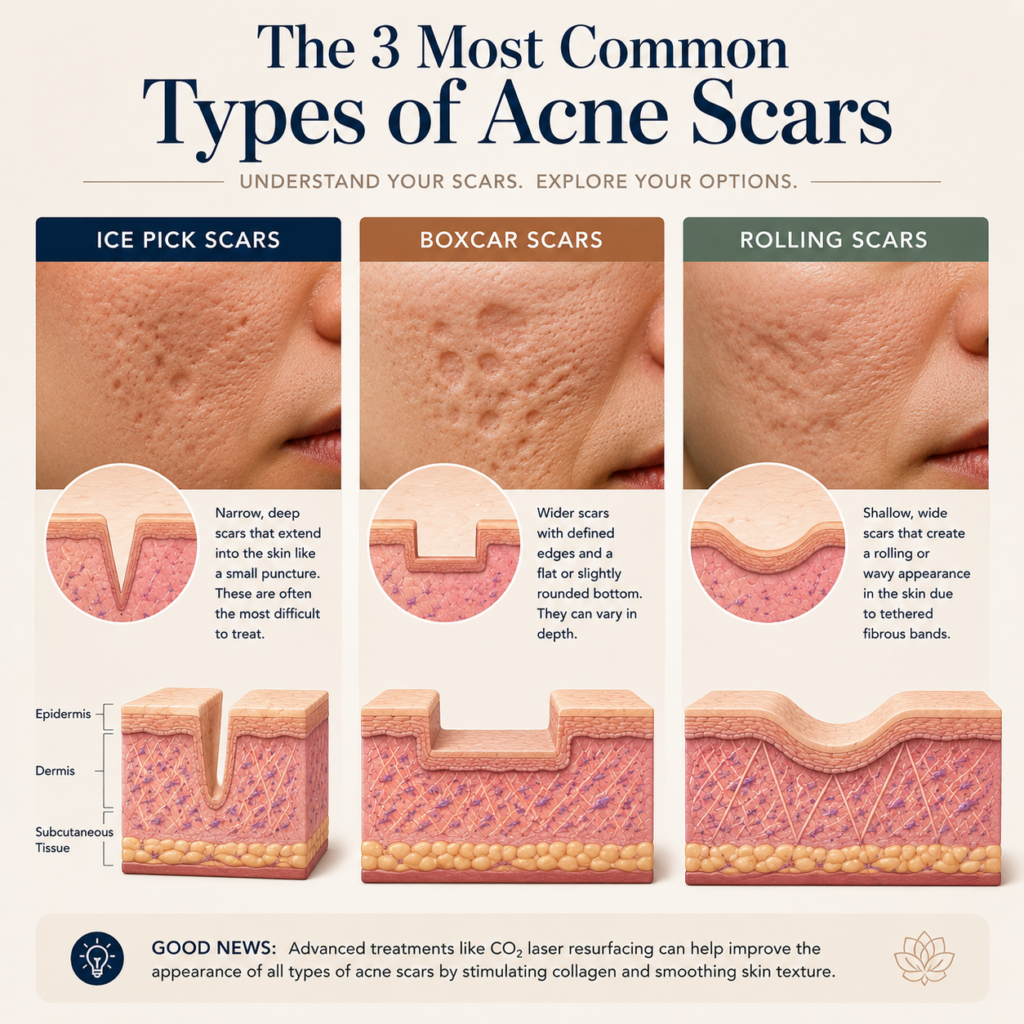
That’s why experienced providers don’t recommend treatment based solely on a photograph or a description over the phone.
A thorough consultation allows your provider to evaluate:
- The depth of your scars
- The type of scarring present
- Overall skin quality
- Skin thickness
- Skin tone
- Previous acne treatments
- Previous laser treatments
- Your goals
- Your lifestyle
- Your desired recovery time
Every one of these factors influences the treatment plan.
The goal isn’t simply treating acne scars.
The goal is creating a personalized approach that helps improve your overall skin quality while setting realistic expectations for the results that can be achieved.
Why This Matters
One of the biggest reasons patients become frustrated with acne scar treatments is unrealistic expectations.
No two people heal the same way.
No two people have identical scars.
And no single treatment is right for every patient.
Rather than looking for a “magic solution,” it’s more helpful to think about acne scar treatment as a process of gradually improving skin quality over time.
That’s exactly why advanced CO2 laser resurfacing has remained an important option in aesthetic medicine—it works with your body’s natural healing process rather than attempting to simply cover imperfections.
How CO2 Laser Resurfacing Helps Improve Acne Scars
One of the biggest misconceptions about CO2 laser resurfacing is that the laser simply “burns away” acne scars.
That’s not what actually happens.
The real power of advanced CO2 laser technology lies in its ability to activate your body’s own healing response.
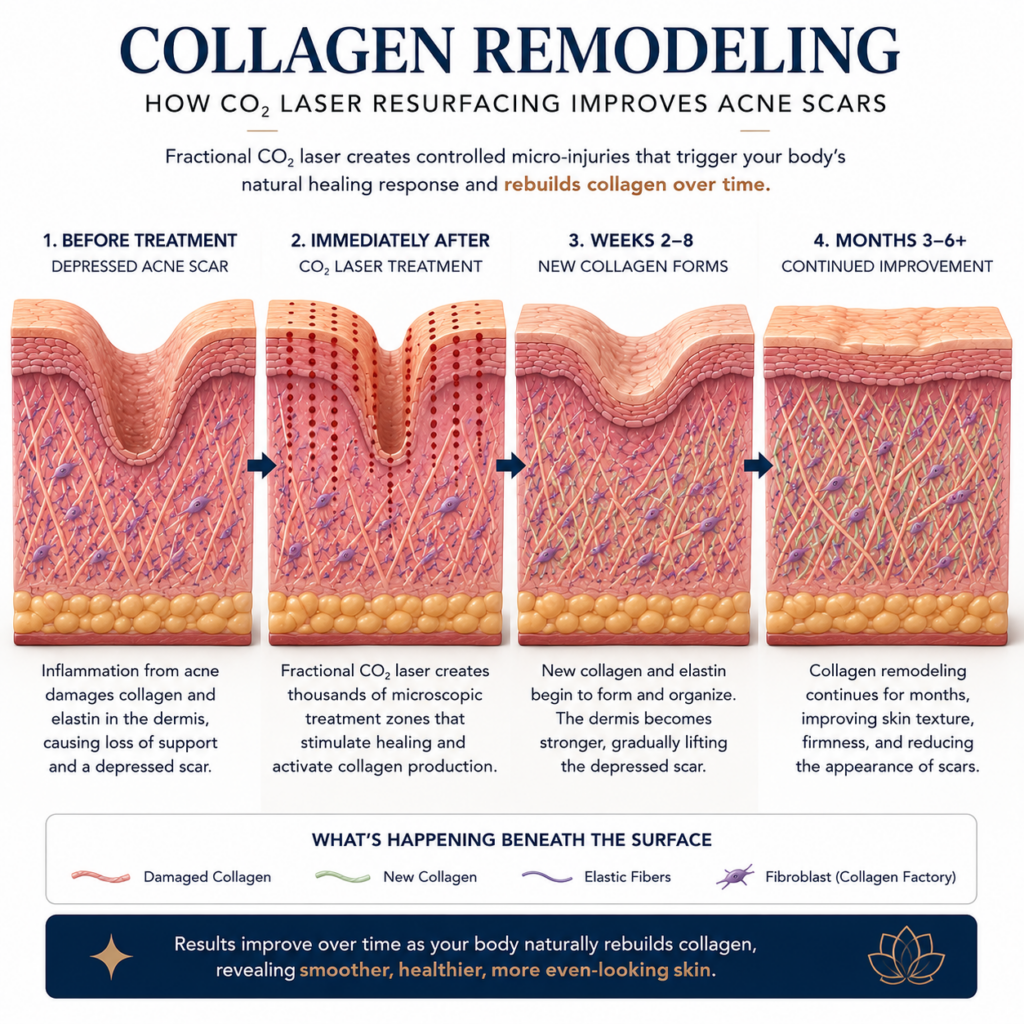
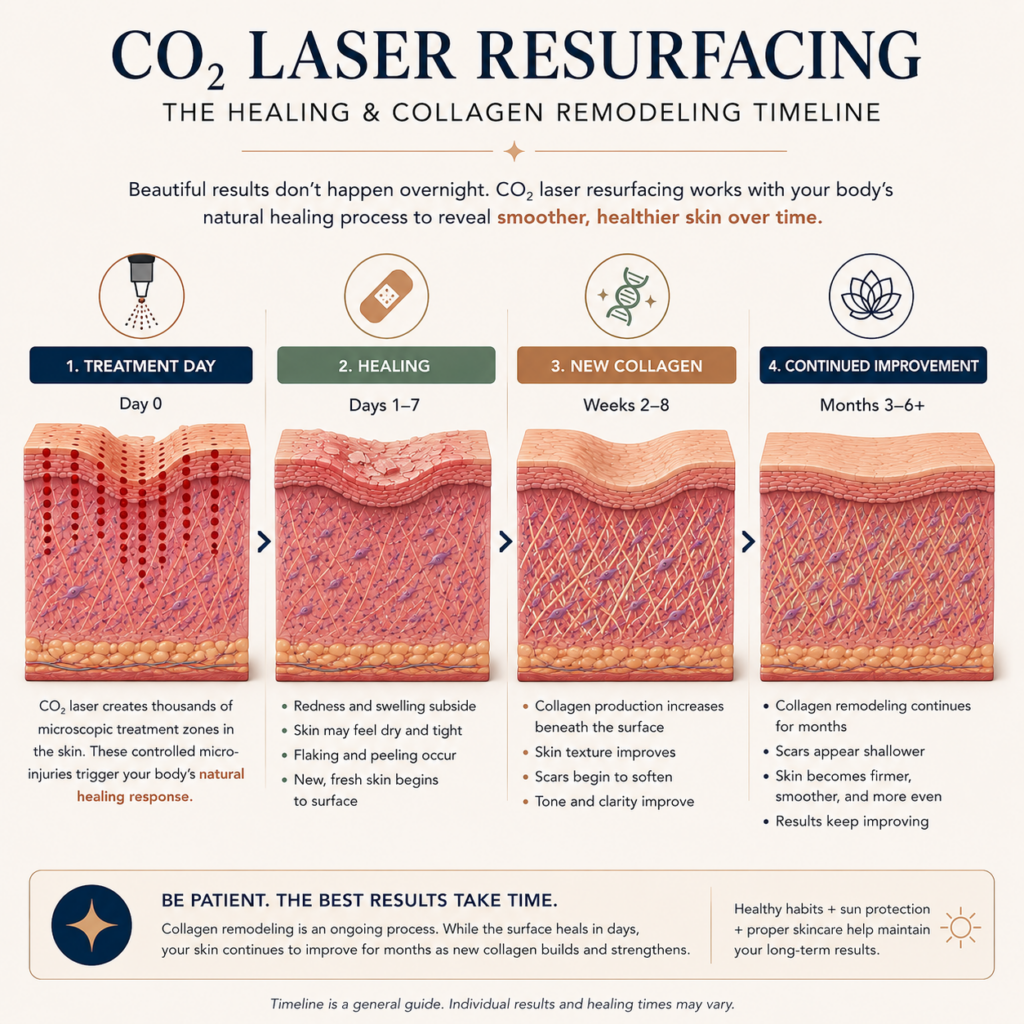
Rather than simply removing damaged skin, fractional CO2 laser resurfacing creates thousands of microscopic treatment zones within the skin. These controlled micro-injuries signal your body to begin repairing itself by producing new collagen and elastin—two essential proteins responsible for maintaining healthy, youthful-looking skin.
As this new collagen develops, it gradually helps rebuild the structural support that was lost when acne damaged the deeper layers of the skin.
Over time, depressed scars become less pronounced because the surrounding tissue gains additional support beneath the surface.
The result isn’t that the scar disappears overnight.
Instead, the transition between healthy skin and scar tissue becomes smoother and less noticeable, creating a more even overall complexion.
For many patients, this gradual improvement is one of the biggest advantages of collagen-stimulating treatments.
Understanding Collagen Remodeling
Think of your skin like the foundation of a home.
When the foundation is strong and level, everything built on top of it appears smooth and stable.
When portions of that foundation sink or become damaged, the surface above begins to show unevenness.
Acne scars develop in much the same way.
Inflammation destroys portions of your skin’s collagen framework, leaving areas with less structural support than the surrounding tissue.
CO2 laser resurfacing encourages your body to rebuild that framework.
After treatment, specialized healing cells called fibroblasts begin producing fresh collagen fibers beneath the treated areas.
These fibers continue reorganizing for weeks and even months after the procedure.
This ongoing remodeling process is why many patients notice their skin continuing to improve long after the initial redness and peeling have resolved.
Instead of masking imperfections, collagen remodeling addresses one of the underlying reasons depressed acne scars exist in the first place.
Why Results Continue Improving After Treatment
Patients often expect laser resurfacing to work like a facial.
They assume they’ll leave the office with immediate final results.
CO2 laser resurfacing works differently.
The treatment itself begins the process.
Your body completes it.
Because collagen production occurs gradually, improvements develop in stages rather than all at once.
Many patients notice something like the following timeline.
The First Week
During the first several days, the focus is healing.
It’s common to experience:
- Redness
- Mild swelling
- Dryness
- Flaking
- A rough or sandpaper-like texture
These changes are part of your skin’s normal healing response.
Following your provider’s aftercare instructions is essential during this stage.
Weeks Two Through Six
Once the skin has largely healed on the surface, something much more important continues happening beneath it.
New collagen production increases.
Patients often begin noticing:
- Improved skin texture
- Softer scar edges
- Brighter skin tone
- Healthier-looking skin
Although these changes may seem subtle at first, they continue building over time.
Months Three Through Six
This is often when collagen remodeling becomes most noticeable.
As new collagen matures, the skin continues strengthening beneath the surface.
Many patients report improvements in:
- Acne scar depth
- Overall skin smoothness
- Skin firmness
- Pore appearance
- Skin quality
Because every patient heals differently, timelines vary, but it’s important to remember that collagen remodeling doesn’t stop when peeling ends.
The skin continues rebuilding itself long after visible recovery has finished.
Why Some Patients Need More Than One Treatment
One question providers hear frequently is: “Will one treatment be enough?”
The answer depends entirely on your skin.
Acne scars often develop over several years.
Likewise, meaningful improvement is usually achieved through a customized treatment plan rather than expecting a single procedure to address every concern.
Your provider considers several factors before recommending the number of treatments, including:
- The type of acne scars present
- Scar depth
- Overall skin quality
- Previous acne treatments
- Previous laser treatments
- Desired level of improvement
- Recovery preferences
Patients with mild textural changes may achieve excellent improvement after a single treatment.
Others with deeper or more widespread scarring may benefit from a series of treatments spaced over time.
Rather than promising identical results for everyone, experienced providers focus on creating a personalized plan designed around your individual skin.
Can CO2 Laser Resurfacing Remove Acne Scars Completely?
This is probably the most important question in the entire article.
The honest answer is: No treatment can guarantee complete removal of every acne scar.
If you ever see advertising promising to erase acne scars permanently after one treatment, it’s worth approaching those claims cautiously.
Modern laser resurfacing is extremely effective at improving skin quality, but medicine should always be honest about what can realistically be achieved.
Most patients seek improvement—not perfection.
CO2 laser resurfacing helps soften scar edges, stimulate collagen production, improve skin texture, and create a smoother transition between scarred and healthy skin.
For many people, those improvements can be significant enough that scars become much less noticeable in everyday life.
The objective isn’t creating flawless skin.
It’s creating healthier-looking skin that gives patients greater confidence.
Why Combination Treatments Sometimes Produce the Best Results
One of the biggest advantages of modern aesthetic medicine is that providers are no longer limited to recommending a single treatment for every concern.
Many patients have more than one type of acne scar.
Others also have enlarged pores, uneven pigmentation, or early signs of aging.
Depending on your skin evaluation, your provider may recommend combining CO2 laser resurfacing with other therapies to achieve more comprehensive improvement.
Your personalized treatment plan may include:
- Medical-grade skincare to support healing
- Treatments designed to improve pigmentation
- Collagen-supporting procedures
- Long-term skin maintenance recommendations
- Daily sunscreen to protect newly rejuvenated skin
The goal isn’t performing more procedures.
The goal is recommending the right combination of treatments for your unique skin concerns.
Key Takeaways
By now, you should understand several important concepts about acne scar treatment:
- CO2 laser resurfacing works by stimulating collagen production rather than simply removing scars.
- Collagen remodeling continues for months after treatment.
- Different acne scar types respond differently to treatment.
- Meaningful improvement often requires a personalized treatment plan.
- The objective is healthier, smoother-looking skin—not unrealistic perfection.
Every patient’s skin tells a different story, which is why every treatment plan should be customized. Understanding how collagen remodeling works helps set realistic expectations and allows patients to make informed decisions about their care.
Recovery After CO2 Laser Resurfacing for Acne Scars
One of the first questions most patients ask is: “How long does recovery take?”
The answer depends on several factors, including the treatment settings used, the depth of the acne scars being treated, your skin type, and your body’s natural healing response.
Because every treatment is customized, every recovery is unique.
However, understanding the healing process can help set realistic expectations and make the experience much less intimidating.
Day One
Immediately after treatment, it’s common for the skin to appear red and feel similar to a moderate sunburn.
Some patients also experience:
- Mild swelling
- Warmth
- Tightness
- Sensitivity
These responses are completely normal and indicate that your body’s healing process has begun.
Your provider will review detailed aftercare instructions and recommend products that help support proper healing while protecting the skin.
Days Two Through Four
Over the next several days, the skin begins replacing damaged surface cells with fresh, healthy skin.
Many patients notice:
- Dryness
- Flaking
- A rough or sandpaper-like texture
- Mild itching as the skin heals
Although it can be tempting to exfoliate or pick at peeling skin, it’s important to allow the healing process to occur naturally.
Proper aftercare plays a significant role in achieving the best possible outcome.
Week One
As the initial healing phase comes to an end, many patients begin noticing smoother, healthier-looking skin.
While some redness may still be present, the surface of the skin often feels noticeably softer.
It’s important to remember that although the skin looks better on the outside, collagen remodeling is still occurring beneath the surface.
Months One Through Six
This is where many of the most meaningful improvements begin.
As collagen production continues, patients often notice gradual improvements in:
- Acne scar appearance
- Skin texture
- Skin firmness
- Overall skin quality
- Pore appearance
Unlike treatments that provide only temporary cosmetic improvement, collagen remodeling helps create structural changes within the skin that continue developing over time.
For many patients, the skin looks better several months after treatment than it did just a few weeks afterward.
Who Is a Good Candidate for CO2 Laser Resurfacing?
While CO2 laser resurfacing is one of today’s most effective collagen-stimulating treatments, it’s not automatically the right choice for everyone.
Ideal candidates often include individuals who have:
- Mild to moderate rolling scars
- Boxcar acne scars
- Uneven skin texture
- Long-standing acne scarring
- Healthy skin without active infection
- Realistic expectations regarding treatment outcomes
Patients with active acne may first benefit from controlling breakouts before beginning scar revision treatments.
Likewise, your provider will evaluate your medical history, medications, skin type, previous treatments, and overall skin health before recommending a personalized treatment plan.
This consultation is one of the most valuable parts of the process because it ensures your treatment is based on your individual needs—not simply what worked for someone else.
Frequently Asked Questions About CO2 Laser Resurfacing for Acne Scars
Can older acne scars still improve? Yes.
Even acne scars that have been present for many years may improve because CO2 laser resurfacing stimulates new collagen production rather than simply treating recent skin damage.
While older scars may require multiple treatments depending on their severity, meaningful improvement is possible for many patients.
Does CO2 laser resurfacing also improve acne discoloration? It can improve overall skin tone and texture, but discoloration and depressed acne scars are two different concerns.
Depending on your skin evaluation, your provider may recommend combining laser resurfacing with other treatments that specifically target pigmentation for more comprehensive improvement.
Can patients with darker skin tones receive CO2 laser resurfacing? Many patients with darker skin tones can safely receive advanced laser treatments, but careful evaluation is essential.
Treatment settings, skin preparation, and post-treatment care may all be customized based on your skin type to help reduce the risk of unwanted pigmentation changes.
Choosing an experienced provider is especially important for achieving safe, predictable results.
Is there a better time of year to have CO2 laser resurfacing? Many patients prefer scheduling laser resurfacing during the fall or winter because they naturally spend less time outdoors.
However, treatments can often be performed throughout the year when patients carefully follow post-treatment instructions and consistently protect their skin from sun exposure.
In Arizona, daily sunscreen should be part of every skincare routine regardless of the season.
How long do acne scar improvements last? The collagen your body produces following treatment becomes part of your skin’s natural support structure.
Although the aging process continues over time, improvements achieved through collagen remodeling can be long-lasting.
Maintaining healthy skin with medical-grade skincare, sun protection, and appropriate maintenance treatments can help preserve your results for years to come.
Acne Scars Tell a Story—But They Don’t Have to Define Your Skin
For many people, acne scars represent more than changes in skin texture.
They’re reminders of years spent managing breakouts, trying countless products, and feeling self-conscious about their appearance.
The encouraging news is that treatment options have advanced significantly.
Modern CO2 laser resurfacing doesn’t simply focus on the surface of the skin. It works by encouraging your body’s own collagen production, helping improve texture gradually while supporting healthier skin over time.
While no treatment can promise perfect skin, many patients experience meaningful improvements that help them feel more confident in their appearance.
The goal isn’t perfection.
The goal is helping your skin look healthier, smoother, and more refreshed while creating results that appear natural.
Every patient’s skin is different, which is why every treatment plan at Evolve Wellness & Aesthetics begins with a personalized consultation and a thoughtful discussion about your goals.
Continue Your Skin Rejuvenation Journey
If you’d like to learn more about advanced CO2 laser resurfacing—including how it works, what concerns it can address, and what to expect throughout the treatment process—we invite you to explore our comprehensive guide.
Learn More About CO2 Laser Resurfacing
Our complete guide explains:
- How advanced CO2 laser resurfacing works
- The differences between CoolPeel® and traditional CO2 laser resurfacing
- Common skin concerns that may benefit from treatment
- What to expect before, during, and after treatment
- Frequently asked questions about recovery and results
➡ Continue Reading: CO2 Laser Resurfacing Tucson
At Evolve Wellness & Aesthetics, we believe every treatment plan should begin with understanding your skin—not simply choosing the latest technology.
Using the advanced DEKA SmartXide Tetra® CO2 laser platform, our experienced team creates personalized treatment plans designed to improve acne scars, uneven texture, sun damage, and other common skin concerns while supporting healthy collagen production.
Whether you’re just beginning to explore laser resurfacing or comparing treatment options, we’re here to answer your questions, evaluate your skin, and recommend the approach that’s right for your goals.
If you’re ready to learn whether advanced CO2 laser resurfacing is appropriate for you, we invite you to schedule a personalized consultation.